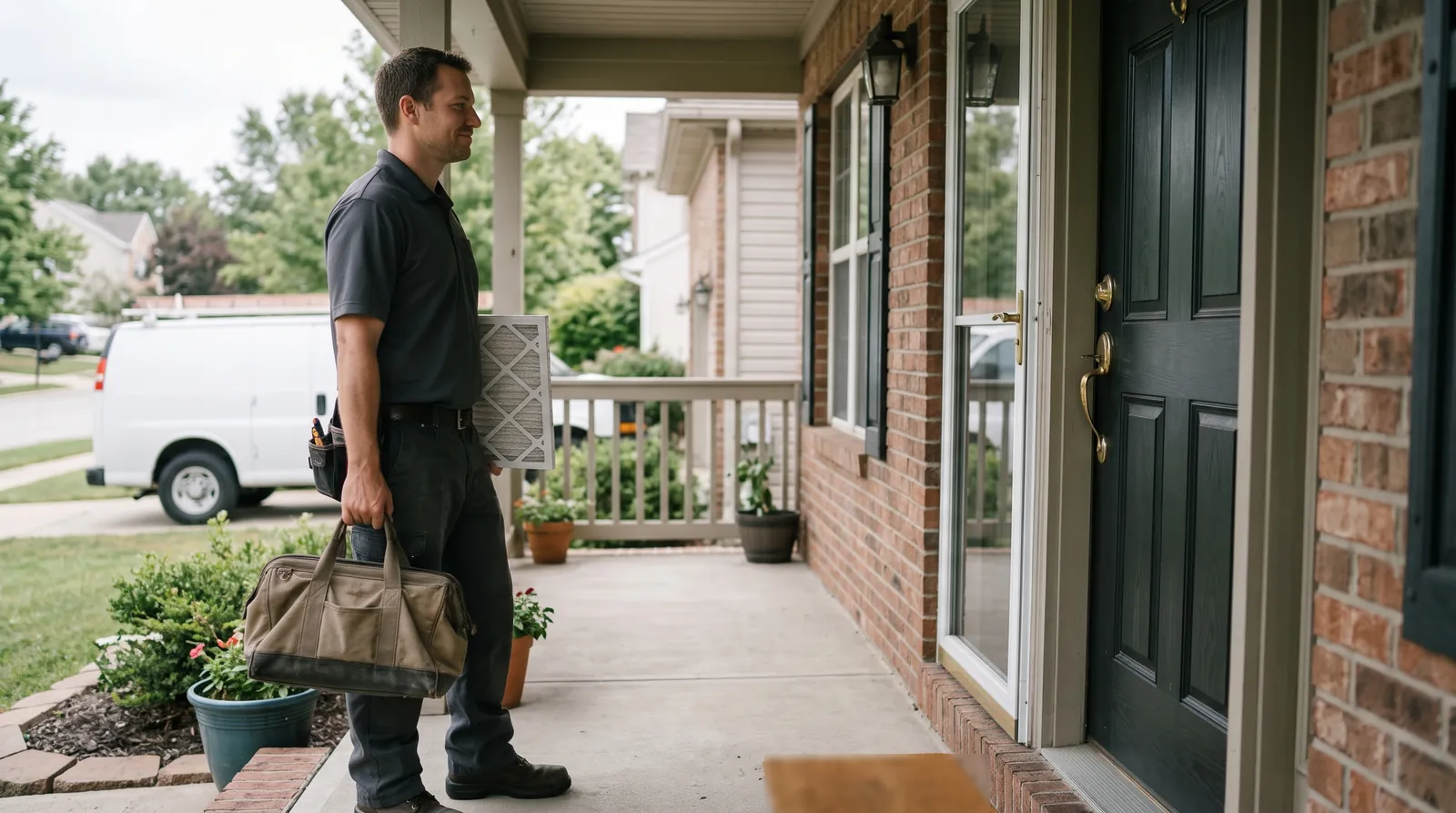
How to choose a marketing agency for contractors: 12 questions to ask
To choose a marketing agency as a contractor, ask questions you can check. Here are 12, with good and bad answers, red flags and a checklist for the call.
 By the Yellowside team
Published
14 min read

The short version
- Ask questions you can check: whose name your accounts are in, how sold jobs get counted, who does the work, and how you leave.
- Your ad accounts, website, domain and Google listing belong in your company's name, with you as the admin. An agency needs access to do the work, never ownership.
- A report you can run your company on counts sold jobs by source and what each one cost. Clicks and rankings only show that the ads ran.
- Ask who listens to your calls. In Invoca's 2026 call data, only 52% of callers to home service businesses spoke with a person.
- Keep looking if you hear a ranking guarantee, see accounts in the agency's name, or get a lock-in with a fee to leave.
On this page
- What should I have ready before I talk to an agency?
- Who will own my ad accounts, website and Google listing?
- How will you show me which jobs the marketing sold?
- Who will do the work, and who answers when leads drop?
- What should happen in the first 90 days after I sign?
- What should the contract say before I sign?
- What are the red flags that mean I should walk away?
- Which questions should I print and take to the call?
To choose a marketing agency for your contracting company, ask questions you can check: whose name your ad accounts, website and Google listing will be in, how the agency will show you which sold jobs came from its work, who will do the work, and how you leave. A good agency answers each one in a sentence or two and puts it in the contract. Ranking guarantees, vague answers, long lock-ins and reports that stop at clicks are your signs to keep looking.
Each question below comes with a good answer and a bad one. The full list is at the end, ready to print.
What should I have ready before I talk to an agency?
Before you talk to a marketing agency, have last month's numbers ready: leads by source, appointments, sold jobs, your average sold job and your spend by vendor. Add a list of who holds every login. Then you can judge each answer against your business.
| What to write down | Where to find it | Your answer |
|---|---|---|
| Leads last month, by source | CRM, call tracking, lead seller invoices | |
| Appointments booked | CRM or the schedule | |
| Sold jobs | CRM or your job list | |
| Average sold job | Sales divided by sold jobs | |
| Marketing spend, by vendor | Invoices and card statements, with ad spend and fees apart | |
| Who holds each login (ads, website, domain, Google listing, call tracking, CRM) | Your office manager and each vendor |
A good agency asks for these numbers before it talks about its fee. Expect questions about your average job, how many leads turn into appointments and sold jobs, how many jobs your crews can take, your service area, and your busy and slow months. A package quoted on the first call, before a single question, is a sign it sells everyone the same thing.
An audit needs read-only access at most, and often no logins at all. For a search audit, Google's own advice is to "only grant read access to Search Console (at this stage, don't grant them write access)" (Google Search Central).
Picking well matters. In a 2025 survey of 500 US small businesses by vcita, a software company, 40% of those who outsource their marketing ended up dropping or switching their agency. More than half of those switches (56%) came 6 to 12 months in, and 60% of those who left blamed a lack of return. A wrong pick can cost you six months to a year.
Who will own my ad accounts, website and Google listing?
Your company should own your Google Ads and Facebook ad accounts, your website and domain, and your Google Business Profile, with you as the admin. The marketing agency gets manager or partner access to do the work. Then you keep the data and can remove the agency when you leave.
1. Whose name will my Google Ads and Facebook ad accounts be in?
A good answer sounds like: "Yours. If you don't have them yet, we set them up under your company with your card for the ad spend. You're the admin, and you give us access."
Keep looking if you hear: "We run your ads through our own account. It performs better." Or "You'll get a login to see the reports." That's view-only access.
Why it matters: in Google Ads, only an Admin can give access, change access levels and unlink a manager account (Google Ads Help). An agency usually works from its own manager account, and your account still owns its data and can unlink that manager. So be the admin on the account itself.
2. Who owns my website and domain, and can I take the site with me?
A good answer sounds like: "You do. The domain is registered to your company, and if you leave, you get the site files or the hosting login."
Keep looking if you hear: "It's built on our platform and it's included while you're a client." Or "You can buy it out when you leave." Or a long story about licenses.
3. Will I stay the owner of my Google Business Profile?
A good answer sounds like: "Yes. You stay the primary owner and add us as a manager."
Keep looking if you hear: "We need to be the owner to manage it."
On a Google Business Profile, managers have mostly the same access as owners, but they can't add or remove users or remove the profile, and only owners can remove owners and managers (Google Business Profile Help).
Check who owns what today. It takes a few minutes.
- Google Ads. Click Admin, then Access and security. Your own email should show Admin access.
- Google Business Profile. Open your profile, then More, then Business Profile settings, then People and access. You should be the primary owner.
- Your domain. Sign in where the domain is registered. The registrant should be your company. If nobody in your company has that login, that's your answer.
- Facebook. In your business settings, the ad account and the page should sit under your own business, with the agency as a partner.
- Call tracking and the CRM. Both in your company's name, with a login you can use yourself.
An agency needs access to your accounts to do the work. It never needs to own them.
How will you show me which jobs the marketing sold?
A good marketing agency sends a monthly report of sold jobs by source and what each one cost in marketing. It checks those numbers against your CRM or sold-jobs list every month. Clicks, impressions and rankings only show that the ads ran.
4. What will your report show me every month?
Add the follow-up: how do you tie a sold job back to the ad or listing it came from?
A good answer sounds like: "Calls and forms by source, how many became appointments, how many became sold jobs, and what each sold job cost in marketing. We match it to your CRM or your sold-jobs list every month, so we'll need that from you."
Keep looking if you hear: a report of impressions, clicks, traffic and rankings with no jobs in it. Or "our platform tracks conversions," when a conversion only means someone filled in a form.
Ask to see a sample monthly report, names removed, and hold it up against this table.
| Shows the ads ran | Shows what you earned |
|---|---|
| Impressions | Appointments booked, by source |
| Clicks | Sold jobs, by source |
| Website visits | Sales from those jobs, by source |
| Ranking for one search | Calls answered and booked |
| Cost per lead | Cost per sold job |
More leads at a lower cost per lead can still mean fewer sold jobs, each costing more. Here is how to work out what each sold job really costs you.
5. Do you listen to my calls, and what happens to a lead after it comes in?
A good answer sounds like: "Yes. We check how fast every web lead gets an answer, listen to a sample of your calls every week, and tell you which ones didn't book and why."
Keep looking if you hear: "We don't share call recordings." Or "the leads are bad," with no calls reviewed.
The call is where a paid lead becomes a job or doesn't, and Invoca's call data shows how much slips there:
52%
55%
An agency judged only on lead count has no reason to look past the first ring. So ask who will. If the agency only runs ads, someone else has to own the calls: you or your office manager. Either way, ask the agency to send you the call recordings.
Two guides help with this part: how fast to answer a new lead and how to book more of the calls you get.
Who will do the work, and who answers when leads drop?
Before you sign with a marketing agency, meet the named people who will do the work on your account. One of them should own your numbers from the ad to the sold job. When leads drop, that person finds out why, and nobody can point at another vendor.
6. Who exactly will work on my account?
A good answer sounds like: names and roles. Who runs your ads, who makes them, who you call, and how fast they answer. "And you'll meet them before you sign."
Keep looking if you hear: "a team of experts," with no names. Or you only ever talk to the salesperson. Or they won't say whether the work goes out to another company.
Also ask how many accounts each person handles, and whether they work for a competitor in your town.
7. When leads drop, who figures out why?
A good answer sounds like: "We do. We'll show you where it starts: fewer clicks, fewer calls from the same clicks, or fewer booked jobs from the same calls. Then we tell you what we're changing."
Keep looking if you hear: "That's probably your website." Or "it's the season," with no numbers to show it.
With an ad agency, a web designer, a lead seller and a social media person, each one shows you its own numbers. You're the one left connecting them. Fix it one of two ways: hire one team that runs all of it, or keep your vendors and name one person who looks at the whole picture every week.
8. How will you get us more reviews?
A good answer sounds like: "We help your team ask every customer after the job, by text or email with a direct link. And we answer reviews in your company's name."
Keep looking if you hear: "We can get you 50 five-star reviews this month." Or "we only send the link to happy customers."
What should happen in the first 90 days after I sign?
In the first 30 days after you sign, a good marketing agency makes you the admin on every account, tracks every call and form to its source, and fixes the basics before it spends more. By day 90 you should see sold jobs by source, what each one cost, and a plan for the next 90 days.
9. What will you do in the first 30 days?
A good answer sounds like: a dated list for month one: accounts in your name, tracking from each call and form to the sold job, and what gets fixed before more money is spent.
Keep looking if you hear: "We rebuild your website first, and ads start in a few months." Or "we'll turn the ads on right away," with no tracking in place.
10. What should I see by day 90, and what happens if I don't?
A good answer sounds like: the agency names the numbers it will move, like appointments per 100 leads and cost per sold job by source. It says what can move fast (ads, follow-up), what takes longer (Google rankings), and what it will change if you're behind.
Ask Google's own question, word for word: "What kind of results do you expect to see, and in what timeframe? How do you measure your success?" (Google Search Central)
Keep looking if you hear: "We guarantee page one." Google's words: "No one can guarantee a #1 ranking on Google," and if someone guarantees first place, "find someone else." Also "give it a year," with nothing to measure along the way.
Ask how they plan your busy and slow months, too. An HVAC company needs work in the quiet spring and fall. A roofer needs retail jobs when storm work dries up.
The 90-day scorecard
| By | You should be able to see | If you can't |
|---|---|---|
| Day 30 | You're the admin on every account. Every call and form tracked to its source. A first report. | Ask why, in writing. Tracking comes before more spend. |
| Day 60 | Appointments and sold jobs by source. At least one change made because of the numbers. | Ask what they learned and what they changed. |
| Day 90 | Cost per sold job by source. Appointments per 100 leads, against before. A plan for the next 90 days. | Decide on the numbers: keep going, change the plan, or give notice. |
Once a month, open Google Ads, your Google listing and your CRM yourself, and check that they match the agency's report.
What should the contract say before I sign?
A marketing agency contract should state in plain numbers how long it runs, how you leave and what it costs to leave, and what the fee covers. It should also list everything you get back when you leave, with a deadline.
11. How long is the contract, and how do I get out?
A good answer sounds like: the term and the notice period in plain numbers. You know the date you can leave and what it costs, and the fee says what it covers and what's extra.
Keep looking if you hear: a contract that renews by itself unless you cancel in a short window. Or a fee equal to the rest of the term if you leave. Or "we'll get to that later."
12. What do I get back on the day I leave?
A good answer sounds like: a written handover list with a deadline. Admin access to every ad account with its history, the domain and the site files or hosting, the call tracking numbers moved to you, every ad, photo, video and page made for you, and your lead and customer data exported. You already own the Google listing.
Keep looking if you hear: "The ads and the content are ours." Or "the tracking numbers stay with us." Or a fee to release your own data.
Also get it in writing: nothing renews without your written OK, and the ads, photos and pages they make for you are yours. Have your lawyer read the contract before you sign.
Send this email before you sign. A good agency will answer it in writing.
Hi [name],
Before we sign, please confirm these in writing or add them to the contract:
1. Our Google Ads and Facebook ad accounts are in [company]'s name, and I'm the admin.
2. Ad spend is charged to our card, directly by Google and Facebook.
3. Our domain is registered to [company], and we get the site files or hosting login if we leave.
4. I stay the primary owner of our Google Business Profile.
5. The call tracking numbers move to us if we leave.
6. Your monthly report shows leads, appointments and sold jobs by source.
7. The contract runs [length], and I can leave with [notice] notice.
8. When we leave, you hand over everything above within [number] business days.
Thanks,
[your name]
What are the red flags that mean I should walk away?
Any one of these red flags is reason enough to walk away from a marketing agency: a guaranteed #1 spot on Google, accounts set up in the agency's name, reports that never mention sold jobs, a long lock-in with a fee to leave, or an offer to buy or filter reviews.
The full list:
- A guaranteed #1 spot, or page one, on Google.
- Someone calling as Google, or "with Google," who wants payment to keep or fix your listing. Google says it will "never ask you for payment information over the phone or guarantee you a special spot" in its products.
- Accounts, the website or the Google listing set up in the agency's name.
- Reports of clicks, impressions and rankings that never mention sold jobs.
- No sample report you can see before you sign.
- No names for who does the work.
- A long lock-in with an automatic renewal and a fee to leave.
- An offer to write, buy or filter reviews.
- A package and a price before a single question about your business.
- Secrecy about what they change. Google's advice: "Be careful if a company is secretive or won't clearly explain what they intend to do."
- A badge offered as proof of results.
On that last one: the Google Partner badge needs an optimization score of at least 70%, $10,000 in ad spend across the accounts an agency manages over 90 days, and half its strategists certified in Google Ads. It shows the agency spends with Google and passes its tests, a fair baseline. It says nothing about sold jobs for a company like yours.
Which questions should I print and take to the call?
Print the twelve questions and take them to every call with a marketing agency: whose name your accounts are in, how sold jobs get counted, who does the work, and how you leave. Ask each agency the same ones and write the answers side by side.
The 12 questions
- 1. Whose name will my ad accounts be in?
- 2. Who owns my website and domain?
- 3. Will I stay the owner of my Google listing?
- 4. What will your report show, and how do you tie a sold job to its source?
- 5. Do you listen to my calls?
- 6. Who exactly will work on my account?
- 7. When leads drop, who figures out why?
- 8. How will you get us more reviews?
- 9. What will you do in the first 30 days?
- 10. What should I see by day 90?
- 11. How long is the contract, and how do I get out?
- 12. What do I get back on the day I leave?
If you want to hear how we answer all twelve, start with our free growth audit. It begins with your business: we look at your ads, website and Google listing, and ask for a quote the way a homeowner would. Or read how one team takes it all over in the first month.
Questions owners ask
Should I hire an agency that only works with my trade?
Trade experience helps. An agency that knows your trade knows your busy months, your job sizes and how homeowners shop for you. But ask for proof in numbers from a company like yours, and ask whether it works for a competitor in your town. An agency that knows your trade and still can't say who owns your accounts, or can't show sold jobs in its report, is the wrong pick.
Is a long marketing contract always a bad sign?
Not always. Some work takes months, like a new website or climbing in Google results. What matters is that the term and the notice period are written in plain numbers, you know the date you can leave, and everything built for you comes back with you. A long term with an automatic renewal and a fee to leave is the warning sign.
How do I check who owns my Google Ads account and Google listing today?
In Google Ads, click Admin, then Access and security, and look for your own email with Admin access. In your Google Business Profile, open More, then Business Profile settings, then People and access, and check that you are the primary owner. For your domain, sign in where it is registered and check that the registrant is your company. If any of them is not in your name, ask for it in writing this week.
What should I give an agency for a free audit?
Read-only access at most, and often nothing at all. Much of an audit can be done from the outside: your website, your Google listing, your ads and a quote request made the way a homeowner would. Google's own advice for an SEO audit is to give read access to Search Console and hold back the right to change anything at that stage.
Sources
- Do you need an SEO?Google Search Central
- About access levels in your Google Ads accountGoogle Ads Help
- About ownership of client accountsGoogle Ads Help
- Manage your Business Profile owners and managersGoogle Business Profile Help
- Help protect against fraudulent calls and textsGoogle Business Profile Help
- How to become a Google Partner or Premier PartnerGoogle Ads Help
- Federal Trade Commission Announces Final Rule Banning Fake Reviews and TestimonialsFederal Trade Commission, 2024
- FTC Warns 10 Companies About Possible Violations of the Agency's New Consumer Review RuleFederal Trade Commission, 2025
- The Consumer Reviews and Testimonials Rule: Questions and AnswersFederal Trade Commission
- Home Services Lead Conversion Benchmarks ReportInvoca, 2026
- vcita's New Survey of SMB Owners Highlights Marketing Agency Churn Crisis, Client Expectationsvcita, 2025